uppaal-models
Uppaal Model Repository
Box Sorting Conveyor Belt
- Claude Session Report
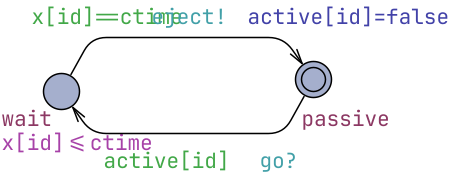
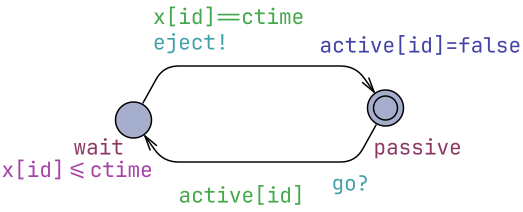
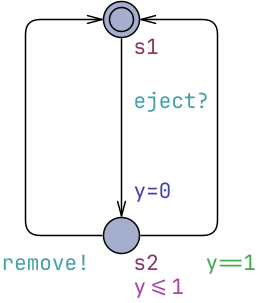
- boxesARTES06.xml original model contains buffer-overflow vulnerability triggered by too many boxes on belt. The fix has not been published before.
- FixedBoxesBig.xml fixed buffer-overflow by Claude (contains state space explosion due to 8 boxes).
- BigBoxesSymmetric.xml state space reduced by symmetry reduction applied by Claude.
| Part | Original model | Fixed buffer overflow | Symmetry reduction |
|---|---|---|---|
| TaskMAIN | 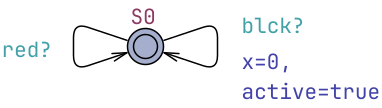 |
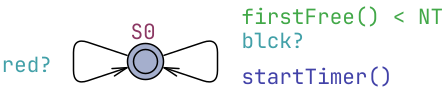 |
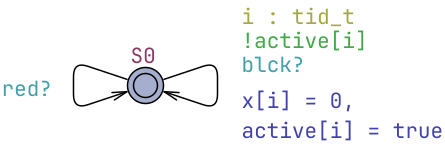 |
| TaskPUSH | 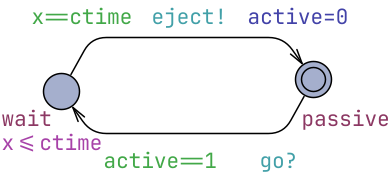 |
 |
 |
| Piston | 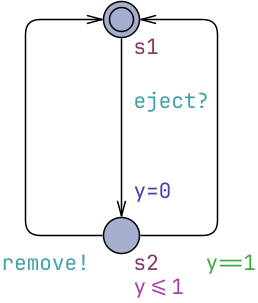 |
 |
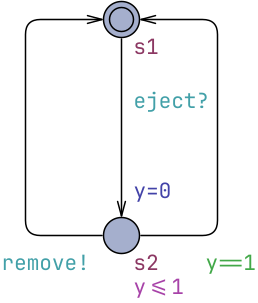 |
| Dumb | 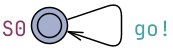 |
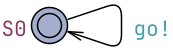 |
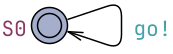 |
| Guard | 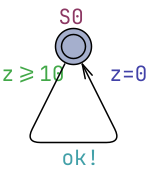 |
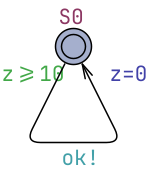 |
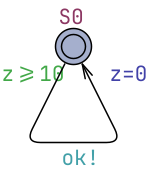 |
| RedBox | 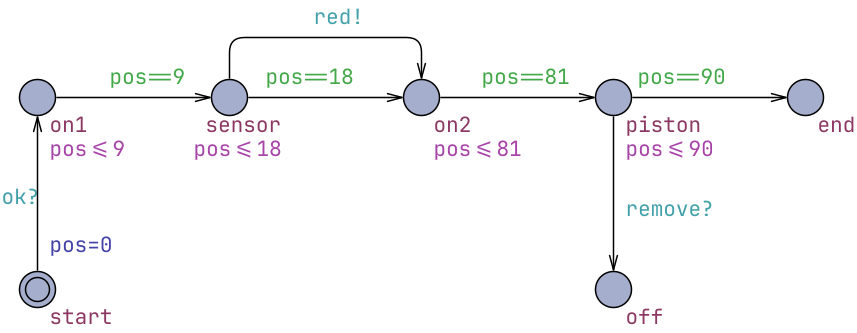 |
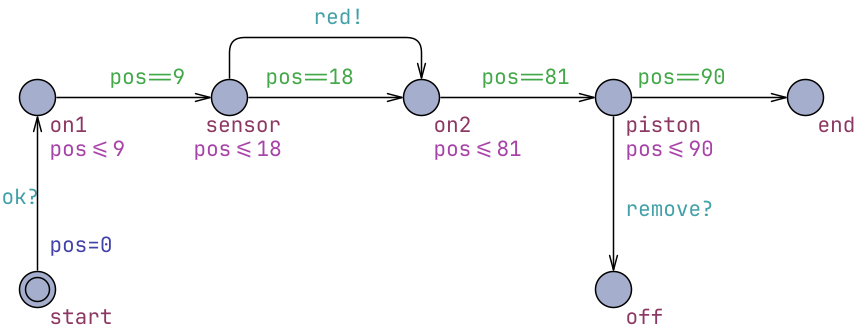 |
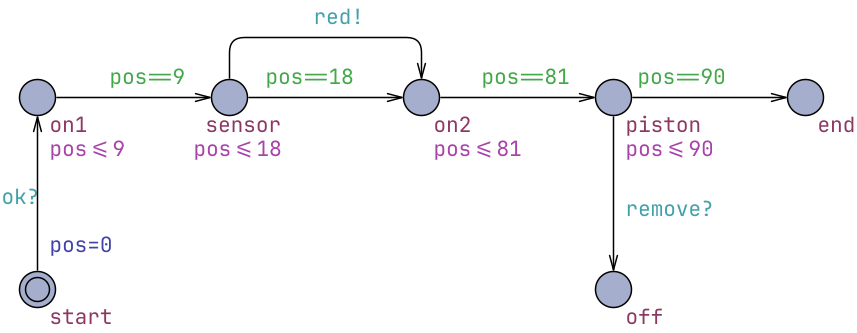 |
| BlackBox | 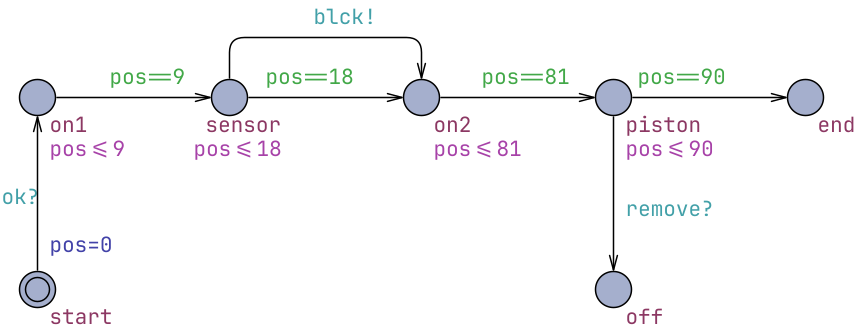 |
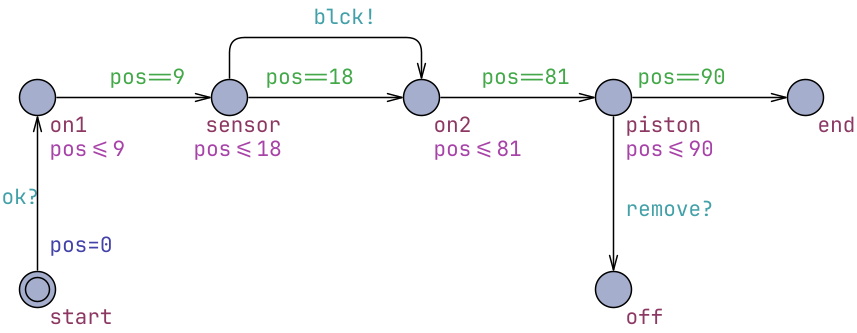 |
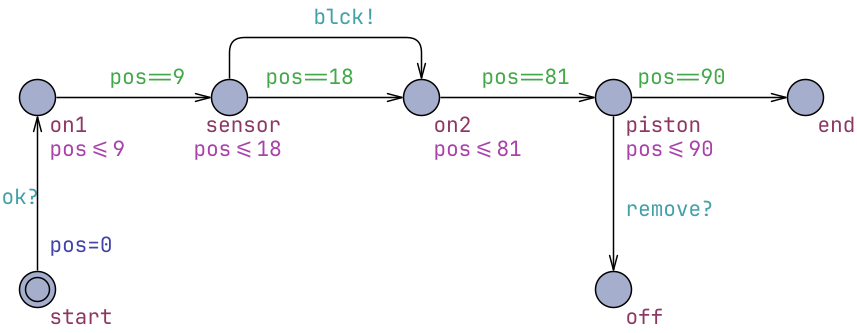 |
Original Global Declarations
const int ctime = 75;

int[0,1] active;
clock x, time;

chan   eject, ok;
urgent chan blck, red, remove, go;
Original Queries
E<> R2.end
E<> R1.end
E<> R1.off
E<> R2.off
E<> B2.off
E<> B1.off
E<> B2.end
E<> B1.end
Fixed Global Declarations
const int ctime = 75;

// Fix: one eject timer per black box that can be in transit between the
// sensor and the piston (previously a single timer x was reset by every
// detection, overwriting the pending eject of an earlier black box).
// Boxes are placed >= 10 apart and travel 75 from sensor to piston, so at
// most 8 black boxes can be in transit at once: 8 timers always suffice.
const int NT = 8;               // number of eject timers
typedef int[0,NT-1] tid_t;

bool  active[NT];               // timer i is counting down to an eject
clock x[NT];                    // timer i: time since its black box was sensed
clock time;

chan   eject, ok;
urgent chan blck, red, remove, go;

// index of a free timer, or NT if all are busy
int[0,NT] firstFree() {
    for (i : tid_t)
        if (!active[i]) return i;
    return NT;
}

// start the first free timer for a newly sensed black box
void startTimer() {
    int i = firstFree();
    x[i] = 0;
    active[i] = true;
}
Fixed Model Queries
// No black box ever reaches the end of the belt.
A[] not (B1.end || B2.end || B3.end || B4.end || B5.end)

// No red box is ever removed from the belt.
A[] not (R1.off || R2.off || R3.off)

// Whenever the system has come to rest, every black box is off and every red box is at the end.
A[] deadlock imply (B1.off && B2.off && B3.off && B4.off && B5.off && R1.end && R2.end && R3.end)

// The intended final outcome is reachable.
E<> B1.off && B2.off && B3.off && B4.off && B5.off && R1.end && R2.end && R3.end

// Stress check: all five black boxes can be between sensor and piston at the same time.
E<> B1.on2 && B2.on2 && B3.on2 && B4.on2 && B5.on2

// Sanity: every pending eject timer stays within its deadline.
A[] TaskMAIN.S0 imply (forall (i : tid_t) (active[i] imply x…
Symmetry Reduction: Global Declarations
const int ctime = 75;

// Fix: one eject timer per black box that can be in transit between the
// sensor and the piston (previously a single timer x was reset by every
// detection, overwriting the pending eject of an earlier black box).
// Boxes are placed >= 10 apart and travel 75 from sensor to piston, so at
// most 8 black boxes can be in transit at once: 8 timers always suffice.
const int NT = 8;               // number of eject timers
const int NB = 5;               // number of black boxes
const int NR = 3;               // number of red boxes

// Scalar sets: identical boxes/timers are interchangeable, which lets
// UPPAAL apply symmetry reduction.
typedef scalar[NT] tid_t;
typedef scalar[NB] bid_t;
typedef scalar[NR] rid_t;

bool  active[tid_t];            // timer i is counting down to an eject
clock x[tid_t];                 // timer i: time since its black box was sensed

chan   eject, ok;
urgent chan blck, red, remove, go;
Symmetry Reduction: Queries
// No black box ever reaches the end of the belt.
A[] forall (i : bid_t) not BlackBox(i).end

// No red box is ever removed from the belt.
A[] forall (j : rid_t) not RedBox(j).off

// Whenever the system has come to rest, every black box is off and every red box is at the end.
A[] deadlock imply ((forall (i : bid_t) BlackBox(i).off) && (forall (j : rid_t) RedBox(j).end))

// The intended final outcome is reachable.
E<> (forall (i : bid_t) BlackBox(i).off) && (forall (j : rid_t) RedBox(j).end)

// Stress check: all black boxes can be between sensor and piston at the same time.
E<> forall (i : bid_t) BlackBox(i).on2

// Sanity: every pending eject timer stays within its deadline.
A[] forall (i : tid_t) (active[i] imply x[i] <= ctime)